
Online dating has changed dramatically over the past decade. What began with simple profiles and basic search functions eventually became a world of algorithms, instant matches, and endless swiping.
But many users now want something different.
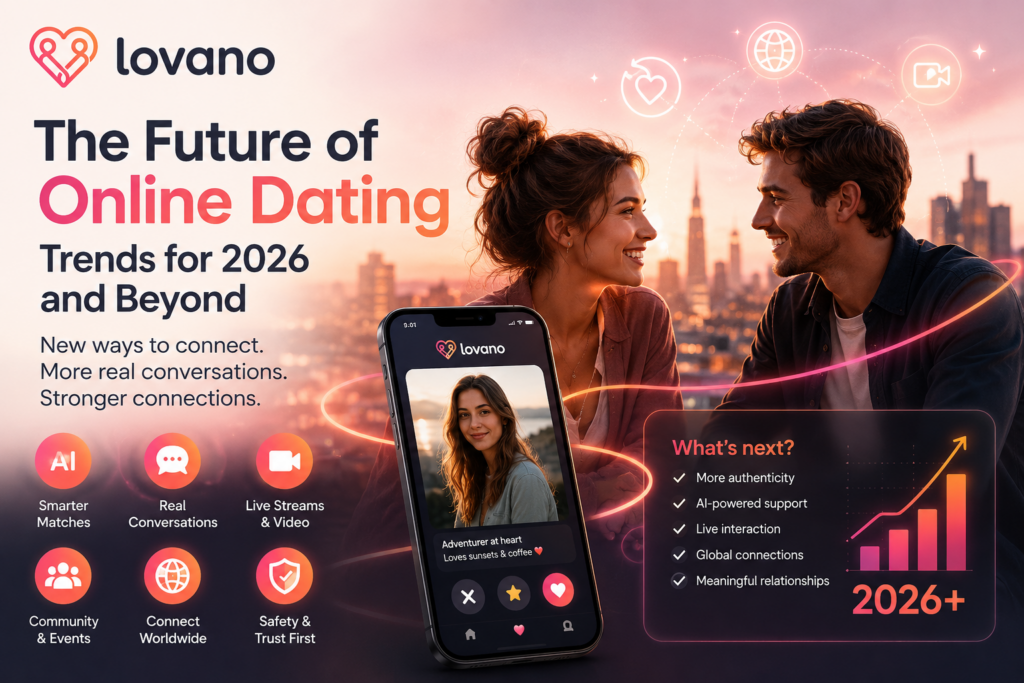
They are becoming more selective about how they spend their time, more open about what they are looking for, and less interested in collecting matches that never become meaningful conversations. Research and product announcements from major dating platforms suggest that clarity, emotional honesty, artificial intelligence, stronger safety features, and more social ways of meeting people will shape online dating in 2026.
So, what could the future of online dating look like?
For years, many dating apps focused on offering users as many profiles as possible. The idea was simple: more choices should create more opportunities to meet someone.
In practice, too much choice can become exhausting.
Users may spend hours swiping, start several conversations at once, and still feel that they are not forming real connections. Dating begins to feel like a repetitive task rather than an exciting social experience.
The next generation of dating platforms will therefore focus less on the number of profiles shown and more on the quality and relevance of each introduction.
One of the strongest dating trends for 2026 is the desire for greater clarity.
People want to understand whether someone is looking for a serious relationship, casual dating, friendship, international connections, or simply new conversations. They also want potential partners to communicate openly instead of leaving them to interpret unclear signals.
Tinder’s 2026 trend research reported strong interest in emotional honesty and clearer communication around dating intentions. This suggests that vague profiles and low-effort communication may become less acceptable to modern daters.
Future platforms may make intentions more visible through profile categories, compatibility questions, conversation prompts, and features that help users communicate what they want without making the experience feel like an interview.
The goal will not be to force people into strict labels. It will be to reduce confusion and help users meet others who are looking for something compatible.
Artificial intelligence is already entering the online dating experience.
It can help users choose stronger profile photos, improve their biographies, discover conversation topics, identify potentially compatible people, and receive suggestions for dates. Tinder’s research found that many young singles were open to using AI as part of their dating journey, particularly for date ideas, photo selection, and profile prompts.
Hinge has also introduced AI-powered tools that provide profile feedback and conversation inspiration. Importantly, its stated approach is to help people express themselves in their own words rather than generating complete messages for them to copy.
This distinction will become increasingly important.
AI should help users communicate more confidently—but it should not pretend to be the user. When every biography, opening message, and reply is completely generated by technology, conversations can quickly lose their personality.
The most successful dating platforms will use AI to support human interaction, not replace it.
The swipe has defined online dating for years, but it may no longer remain the centre of every dating experience.
Instead of presenting hundreds of profiles, future platforms may provide a smaller number of carefully selected recommendations based on interests, behaviour, communication preferences, and relationship goals.
Tinder announced an AI-powered feature called Chemistry, designed to offer a curated daily recommendation rather than requiring users to continue liking profiles endlessly. This is one example of how major dating platforms are experimenting with alternatives to traditional swipe-based discovery.
This does not mean that swiping will disappear immediately. It may become only one discovery option among many.
Users could meet through communities, livestreams, interest groups, local activities, compatibility suggestions, or conversations happening around shared topics.
The future may be less about choosing a face in seconds and more about discovering why someone could be interesting.
Traditional dating apps often create an isolated experience. One person sits alone, looks through profiles, and decides who to contact.
Newer formats are making online dating more social.
Tinder has already introduced features such as Double Date and different discovery modes that allow people to approach dating through shared interests or alongside friends. These formats may reduce pressure and make the experience feel safer and more entertaining.
In the future, users may increasingly meet through:
This approach can create more natural conversation starters. Instead of contacting a complete stranger based only on a photo, people can first observe how someone communicates, what they are interested in, and how they interact with others.
Dating platforms may gradually begin to feel more like active communities and less like silent catalogues of profiles.
Photos and written descriptions can only reveal a limited part of someone’s personality.
Livestreaming and real-time video allow people to show their humour, energy, communication style, interests, and confidence in a much more natural way.
A user might host a casual conversation, share music, discuss travel, answer questions, present a hobby, or simply interact with members of the community. Viewers can participate immediately instead of waiting for a traditional match.
This could make online dating feel more spontaneous and authentic.
Livestreaming may also create opportunities for talented and entertaining streamers to build an audience and earn money through their content and community interactions. On Lovano, the aim is to combine social discovery with opportunities for active streamers to grow their presence and generate income.
However, successful livestreaming systems will also require strong moderation, clear community guidelines, and tools that protect both streamers and viewers.
The traditional dating profile usually consists of a few photographs, a short biography, and basic information.
Future profiles will probably become more interactive.
Voice notes, short videos, interest prompts, livestream highlights, answers to personality questions, and community activity can help users present themselves more naturally.
Hinge’s research found continued interest among younger daters in tools that support deeper communication, including voice notes and AI assistance as a second opinion.
Hearing someone’s voice or watching a short introduction may reveal more than several carefully edited photographs. Dynamic profiles can also give other users more specific material for starting a conversation.
Instead of opening with a generic “Hi,” someone might respond to a story, opinion, hobby, video, or shared interest.
As artificial intelligence improves, fake photographs, automated conversations, impersonation, and deepfake videos may become more difficult to recognise.
Dating platforms will therefore need stronger systems for identifying suspicious behaviour and confirming that users are genuine.
Several services are already investing in identity checks, age verification, automated moderation, and AI-assisted scam detection. Bumble, for example, uses AI-supported features to identify suspicious profiles and potentially inappropriate images.
Future safety features may include:
Technology can reduce risk, but users will still need to remain careful. No verification system can guarantee that every person has good intentions.
Safety will not be an optional extra. It will become one of the main reasons users choose one platform over another.
Online dating already allows people to meet outside their immediate neighbourhood. In the future, borders and language differences may become even less restrictive.
Real-time translation, international discovery settings, interest-based communities, and improved video communication can make it easier to connect with people from other countries.
This creates opportunities not only for romantic relationships but also for friendships, cultural exchange, language practice, and travel connections.
However, international dating also requires realistic communication. Distance, travel expenses, time zones, cultural differences, and future plans should be discussed honestly.
The technology may make the introduction easier, but both people still need to decide whether the relationship can work in everyday life.
A good dating platform should not keep users messaging forever.
Many users want assistance taking the next step, especially when a conversation is going well but neither person knows how to suggest meeting.
Bumble began testing a feature that allows users to signal that they are ready to arrange a date. According to the company, it was designed to reduce the uncertainty that often causes promising conversations to stall.
Future dating platforms may offer:
The objective should be to turn digital introductions into genuine human experiences—not to keep people permanently active inside an app.
The future of digital romance may not be defined only by dramatic gestures.
Bumble’s global dating research found that many singles consider small actions—such as sharing a meme, sending a playlist, or creating an inside joke—to be meaningful expressions of affection.
Dating platforms can support these smaller moments through shared media, virtual gifts, reactions, playlists, private activities, and personal reminders.
These features may seem simple, but relationships are often built through consistent, everyday attention.
A thoughtful message sent at the right moment can be more meaningful than a perfectly designed profile.
As dating apps collect more information to improve compatibility, users will naturally ask more questions about how their information is being used.
Do algorithms analyse private conversations? Are uploaded photographs used to train AI? Which information is shared with other users? Can personal data be deleted?
Platforms that explain these systems clearly will have an advantage.
Users should have meaningful control over their visibility, location information, discovery preferences, profile content, and personal data.
The future of personalised dating will depend on finding a balance: enough information to create useful recommendations, but not so much that users feel watched or exposed.
Trust will need to exist not only between users—but also between users and the platform itself.
Artificial intelligence, livestreaming, smarter algorithms, real-time translation, and interactive profiles can improve how people meet.
But technology cannot create genuine compatibility on its own.
It cannot guarantee attraction, replace emotional honesty, or build trust without effort from both people.
The future of online dating should therefore not be about making the experience more automated. It should be about removing unnecessary barriers so that real people can communicate more naturally.
The best technology will become almost invisible. It will help users discover each other, feel safer, express themselves, and begin conversations—then allow the human connection to take over.
Lovano is being developed around the belief that online dating should offer more than endless swiping.
The vision is to create a social and international platform where users can discover personalities, participate in communities, communicate in real time, and build meaningful connections.
With community features, livestreaming, international discovery, genuine interaction, and earning opportunities for streamers, Lovano aims to bring dating and social connection together in one active environment.
The future of online dating will not only be about finding more profiles.
It will be about creating better opportunities to meet the person behind the profile.
Lovano is growing, and many exciting features are still to come.
Subscribe to the Lovano newsletter to receive dating advice, development updates, launch announcements, community news, and exclusive surprises directly in your inbox.
Subscribe now and be part of the future of Lovano from the beginning.