

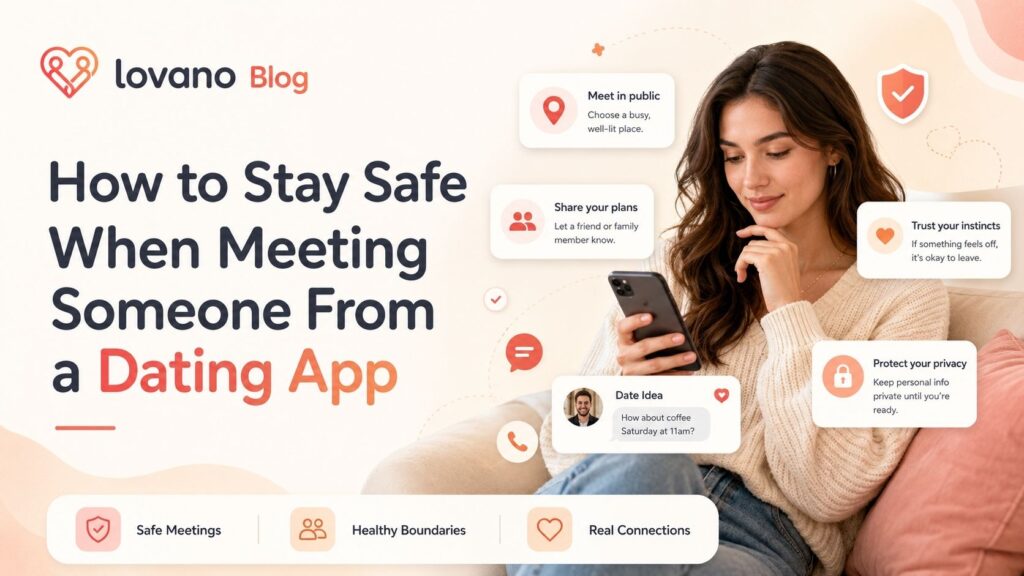
Meeting someone from a dating app can be exciting. After days or weeks of messaging, you finally have the opportunity to discover whether the connection feels just as natural in person.
Most first dates are simply two people getting to know each other. However, you are still meeting someone whose identity, intentions, and behaviour you do not yet fully know.
Safety precautions are not about assuming that everyone is dangerous. They are about staying in control of the situation while trust develops naturally.
No precaution can guarantee complete safety or prevent another person from behaving badly. However, thoughtful planning can reduce risk and help you feel more confident. If someone ever harms, pressures, or threatens you, responsibility belongs to that person—not to you.
You never have to meet someone before you feel ready.
Spend enough time talking to understand their personality, intentions, and communication style. Ask questions, pay attention to whether their answers remain consistent, and notice how they react when you establish a boundary.
Someone who genuinely respects you should also respect your pace. Pressure to meet immediately—especially in a private location—is a reason to slow down rather than move faster. RAINN recommends meeting only when you feel comfortable and treating pressure to meet quickly as a warning sign.
You could say:
“I’m enjoying our conversation, but I’d like to get to know you a little better before meeting.”
A respectful match will understand.
A short video conversation can help you become more comfortable before meeting in person.
It allows you to confirm that the person generally resembles their profile, observe how they communicate in real time, and decide whether the interaction feels natural.
However, a video call is not a complete identity or safety check. The FBI has warned that scammers can use artificial intelligence to create convincing images and videos, while dating-platform verification badges also do not guarantee that a person is safe. Treat video calls and verification as useful signals—not absolute proof.
If someone repeatedly avoids video calls while offering changing or unlikely excuses, remain cautious. Avoiding both video calls and in-person meetings is a recognised warning sign in romance scams.
During the early stages of online dating, avoid revealing information that could make it easy for someone to locate you or understand your daily routine.
This may include:
Be cautious when linking a dating profile directly to public social-media accounts. Those accounts may reveal your full name, friends, workplace, neighbourhood, or frequently visited locations before trust has been established.
You can be open and genuine without sharing every private detail immediately.
Pay attention when details repeatedly change.
Someone may give different answers about their age, job, location, relationship status, or personal history. Their profile photos may also appear unusually polished, inconsistent, or disconnected from the life they describe.
Searching a profile photo through a reverse-image search can reveal whether it appears under another name or has been taken from another website. Both the FTC and FBI recommend researching suspicious photos and profile details when something does not seem right.
Research cannot prove that someone is trustworthy, but obvious contradictions are a reason not to ignore your concerns.
Requests for money are one of the clearest dating-scam warning signs.
The person may describe a medical emergency, travel problem, unpaid bill, investment opportunity, visa issue, or crisis that supposedly prevents them from meeting you. They may ask for a bank transfer, gift card, cryptocurrency, or access to a financial account.
Do not send money, gifts, financial details, or cryptocurrency to someone you have only met online. The FTC advises never sending money or gifts to an online romantic interest you have not met in person, while the FBI also warns against urgent financial requests and pressure to keep them secret.
If you have already transferred money and believe you were deceived, contact your bank or payment provider immediately and report the account to the platform and the appropriate authorities in your country.
For the first few meetings, choose a populated, well-lit place where other people and staff members are nearby.
Good options may include:
Avoid meeting for the first time at your home, their home, an isolated beach, a remote hiking trail, a parked car, or an unfamiliar private location.
RAINN recommends public, populated places for the first few dates and advises waiting until trust has developed before visiting each other’s homes.
A simple coffee date is often ideal. It is public, relaxed, and easy to end if the connection does not feel right.
Before leaving, send your plans to a trusted friend or family member.
Tell them:
You could also share your live location for the duration of the date and arrange a specific check-in time. RAINN recommends giving a trusted person your date details and using location sharing when appropriate.
Create a simple code word or emoji that tells your friend you need help leaving. For example, sending a particular emoji could mean: “Call me now and give me a reason to go.”
Arrange your own journey to and from the date.
Drive yourself, use public transportation, book a legitimate taxi or rideshare, or ask a trusted person to drop you off and collect you. Avoid allowing a new match to pick you up from your home because this reveals your address and makes you dependent on them for leaving.
Keep enough battery, money, and transportation options available to return home without assistance from your date. Planning your own transport and an exit strategy allows you to leave quickly if the situation becomes uncomfortable.
You do not need to accept a lift simply because someone offers one politely.
A short first meeting can be safer and more comfortable than committing to an entire evening.
Consider arranging coffee or one drink rather than a long dinner, day trip, or overnight stay. You can always extend the date when both of you feel comfortable.
It may also help to create a natural ending:
“I’m free for coffee from 5:00 until around 6:30.”
This gives you an easy opportunity to leave without needing to invent an excuse.
A short date is not a sign of low interest. It is simply a sensible first step.
Keep your drink with you and avoid leaving it unattended.
When possible, watch it being prepared or opened. Do not accept an already-open drink from someone you have only just met. If you leave your drink unattended or something seems unusual about it, replace it rather than taking a risk.
Limit alcohol or anything else that could significantly affect your awareness or decision-making. RAINN recommends staying alert, avoiding excessive alcohol consumption, and keeping food and drinks attended during a date.
You never need to drink alcohol to make the date feel relaxed or enjoyable.
A first date reveals more than whether you share hobbies or feel attracted to each other. It also shows how someone responds to the word “no.”
Notice whether they:
Consent must remain voluntary. Agreeing to a date does not mean agreeing to physical intimacy, entering someone’s home, sharing personal information, or continuing the evening.
You may change your mind at any time. If someone crosses your boundaries or makes you uncomfortable, you are entitled to end the date immediately.
Sometimes nothing obviously dangerous has happened, but something still feels wrong.
The person may behave differently from how they communicated online. Their stories may not make sense, their attention may feel controlling, or their attitude may change when you resist a suggestion.
You do not need proof of bad intentions before leaving.
You also do not need to stay because you are worried about appearing rude. Your comfort and safety matter more than completing the date or protecting a stranger from disappointment.
RAINN advises trusting your instincts and leaving as quickly and safely as possible when something does not feel right.
Before the date, think about what you will do if you want to leave.
Your plan could include:
You do not owe anyone a detailed explanation.
You can simply say:
“I’m going to leave now. Take care.”
When directness feels unsafe, prioritise getting away rather than explaining yourself. RAINN notes that it is acceptable to leave early, use an excuse, or walk away when your safety or comfort is at risk.
Be cautious when someone immediately pressures you to move the conversation to another messaging service.
Staying on the dating platform during the early stages can preserve access to reporting, blocking, and moderation tools. RAINN recommends resisting pressure to leave the app too quickly because external messaging channels may not provide the same protections.
Moving to another platform is not automatically suspicious. The important question is whether the person respects your decision when you prefer to wait.
A verified badge may indicate that someone completed a particular identity or photo-checking process. It can be useful, but it should never replace your judgment.
Tinder explicitly states that photo verification does not guarantee a person’s identity or safety. Verification may confirm that a live face resembles profile photos, but it cannot reveal someone’s intentions or predict their behaviour.
Use verification as one piece of information alongside conversations, consistency, boundaries, and careful first-date planning.
Report a user when they:
Blocking protects your own account, while reporting may help the platform investigate the behaviour and protect other members.
If you believe a crime has occurred or you are in immediate danger, move to a safe place and contact the relevant emergency or law-enforcement services where you are located. If you experience harassment, assault, or abuse, what happened is not your fault.
One unusual detail does not always mean someone is dangerous. However, several warning signs together should be taken seriously.
Be especially cautious when someone:
The FBI identifies rapid declarations of love, refusal to meet, requests for money, secrecy, and inconsistent stories as common romance-scam warning signs.
Safety advice must always be discussed carefully.
Following every recommendation cannot guarantee that another person will behave respectfully. Someone who deceives, pressures, assaults, threatens, or harms another person is responsible for their own actions.
The purpose of safety planning is to provide more control and possible exit options—not to suggest that someone caused what happened because they trusted the wrong person or missed a warning sign.
Everyone deserves dates based on consent, honesty, dignity, and mutual respect.
Lovano is being developed to help people communicate, interact, and discover the personality behind the profile.
Our goal is to create a welcoming community where members can build genuine connections through profiles, conversations, international discovery, and livestreams.
Technology can support safer dating through community standards, reporting options, moderation, and tools that encourage authentic interaction. However, every member should continue to protect their privacy, trust their instincts, and take sensible precautions when meeting someone in person.
A meaningful connection should never require you to ignore your boundaries.
The right person will respect your pace, your decisions, and your safety.
Subscribe to the Lovano newsletter for dating advice, community updates, new feature announcements, safety information, and exclusive Lovano news.
Subscribe now and be part of the Lovano journey.