

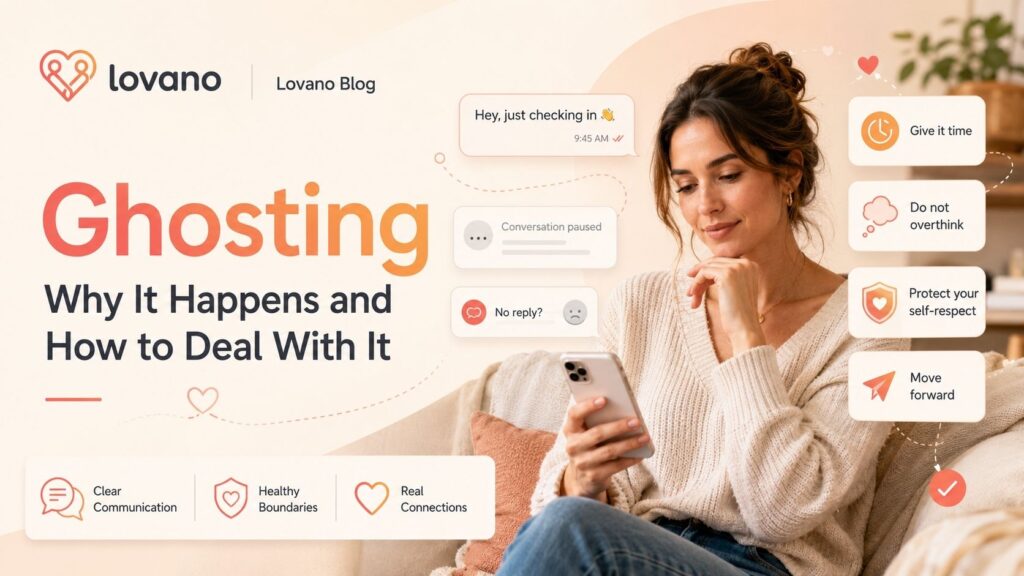
You match with someone, exchange messages, and begin to enjoy the conversation. Perhaps you speak every day, share personal stories, or even make plans to meet.
Then, without warning, they disappear.
No explanation. No final message. No clear reason.
This is known as ghosting, and it has become one of the most frustrating experiences in modern dating. It can leave you feeling confused, rejected, or wondering whether you did something wrong.
Although ghosting can be painful, it often says more about the other person’s communication style than it does about your value. Understanding why it happens can help you respond calmly, protect your confidence, and move forward without spending too much time searching for answers you may never receive.
Ghosting happens when someone suddenly stops communicating without explaining why.
They may stop replying to messages, ignore calls, cancel plans without rescheduling, or disappear after what seemed like a positive conversation or date.
Ghosting can happen at different stages of dating:
The longer and more personal the connection has become, the more painful the disappearance can feel.
When someone stops replying after one short conversation, it may be disappointing. When someone disappears after weeks of regular contact, it can feel like a sudden loss.
There is rarely one universal reason. People ghost for many different reasons, and sometimes the explanation has little to do with the person being ignored.
Ending a connection can feel awkward.
Some people do not know how to say that they are no longer interested. They may worry about hurting the other person’s feelings, receiving an angry response, or having to explain a decision they do not fully understand themselves.
Instead of having an honest conversation, they choose silence.
This may feel easier for them in the moment, but it often creates more confusion and pain for the other person.
Sometimes a person simply decides that the connection is not right for them.
They may have enjoyed the conversation but realised that they do not feel enough romantic interest. They may also have met someone else, changed their dating priorities, or decided that they are not ready to continue.
Losing interest is a normal part of dating. Disappearing without communicating it is the problem.
A respectful message does not need to be long. Something as simple as “I enjoyed talking to you, but I do not feel the connection I am looking for” can provide clarity.
Many dating app users communicate with multiple matches at the same time.
As one connection becomes stronger, other conversations may gradually receive less attention. Some people then allow those conversations to end without formally closing them.
This does not necessarily mean that every earlier interaction was dishonest. However, it can still feel disrespectful when someone disappears after showing consistent interest.
Work, family problems, stress, health concerns, or personal responsibilities can affect how someone communicates.
A person may withdraw from dating because they feel emotionally exhausted or unable to maintain conversations. They may intend to reply later but continue delaying it until so much time has passed that responding feels awkward.
This does not excuse disappearing after building a meaningful connection, but it may explain why some people suddenly become unavailable.
Some people enjoy the excitement of a new connection but become uncomfortable when it starts to feel real.
They may pull away when conversations become more personal, when plans are made to meet, or when emotional expectations begin to develop.
Fear of rejection, previous relationship experiences, or discomfort with vulnerability can cause someone to distance themselves rather than communicate openly.
People who struggle with direct communication may use silence to avoid conflict.
They may believe that saying nothing is kinder than rejecting someone. In reality, uncertainty can be more painful than a clear and respectful answer.
Healthy dating requires the ability to communicate uncomfortable feelings. Someone who disappears instead of having a simple conversation may not currently be capable of offering the communication you need in a relationship.
Two people can experience the same conversation very differently.
One person may feel that a meaningful connection is developing, while the other sees it as a casual exchange without expectations.
This difference can be especially common during the early stages of online dating, when intentions have not yet been discussed.
That does not make your feelings unreasonable. It simply means the level of emotional investment may not have been equal.
Not every delayed reply is ghosting.
Sometimes both people are waiting for the other to continue the conversation. Someone may believe that they sent the last meaningful message or assume that you are no longer interested.
Before concluding that you have been ghosted, consider whether the conversation ended naturally or whether there was a clear unanswered message.
One friendly follow-up can provide clarity.
There is no exact amount of time that applies to every situation.
A delay of several hours is usually normal. People work, sleep, travel, spend time with friends, and sometimes need a break from their phones.
A delay of a day or two may also be reasonable, especially if the person has already mentioned being busy.
Ghosting becomes more likely when:
The context matters. Someone who usually replies several times a day and then disappears for a week has made a noticeable change.
Avoid sending several messages immediately.
A delayed response does not always mean rejection. The person may genuinely be busy or dealing with something unexpected.
Give them enough time to respond without pressure.
When enough time has passed, send one clear and respectful message.
Por ejemplo:
“Hey, I enjoyed talking with you. I have not heard from you for a while, so I wanted to check whether you are still interested in continuing the conversation.”
Or:
“I noticed things have gone quiet. No pressure, but I would appreciate knowing whether you still want to stay in contact.”
This gives the person an opportunity to explain themselves while also showing that you value clear communication.
When your follow-up message also receives no answer, continuing to contact them is unlikely to create a healthy connection.
Repeated messages may leave you feeling more anxious and powerless. They can also keep you emotionally attached to someone who is not showing the same level of interest.
Silence may not be the answer you wanted, but it is still information.
Someone who wants to remain in your life will usually make some effort to communicate.
Ghosting often causes people to replay every conversation.
Was your last message too long? Did you reply too quickly? Were you too honest? Did you say something embarrassing?
It is natural to examine what happened, but do not automatically assume that you caused it.
A person may disappear because of their own fears, priorities, communication habits, or personal circumstances. Even when they decided that the connection was not right, that does not mean you did something wrong.
Not every connection is meant to continue.
When someone disappears, your mind may try to fill in the missing information.
You may imagine that they met someone better, secretly disliked you, were dishonest from the beginning, or were only using you for attention.
Any of these possibilities could be true, but they may also be completely wrong.
Creating painful explanations without evidence can make the situation harder than it needs to be.
The only confirmed fact is that they stopped communicating. That alone is enough to decide how much more energy you want to invest.
You may have liked their personality, felt strong chemistry, or imagined what the connection could become.
However, relationships are built on consistent actions, not possibilities.
Someone may appear charming, interesting, and compatible, but if they cannot communicate respectfully, they may not be able to offer the kind of relationship you want.
Pay attention to what they actually do.
You are allowed to feel disappointed. You are also allowed to decide that disappearing without explanation does not meet your standards.
Self-respect does not mean pretending that you do not care. It means recognising that you deserve mutual effort, honesty, and consideration.
Closure does not always come from the other person. Sometimes closure comes from accepting their behaviour and choosing not to wait for them.
Ghosting can create more than simple disappointment. The lack of explanation may leave the situation feeling unfinished.
Do not dismiss your feelings simply because the relationship was new or mostly online.
Emotional connection can develop through messages, calls, and shared experiences. Losing that connection without warning can genuinely hurt.
Give yourself time to process what happened.
A friend can help you see the situation more clearly.
They may remind you that the person’s behaviour was not a reflection of your worth or help you recognise signs that you overlooked because you were emotionally invested.
Try to speak with someone who supports you without encouraging endless analysis.
You do not need to find another match immediately.
When ghosting has affected your confidence, taking a short break from dating apps can help. Focus on your friendships, routines, hobbies, and the parts of life that make you feel grounded.
Return to dating when you feel curious and open again, rather than when you feel pressured to replace the connection.
You are not simply looking for attention or messages. You are looking for someone who communicates, shows effort, and treats you with respect.
Someone disappearing may remove a person who was not able to meet those needs.
That does not make the experience pleasant, but it can help you see that the loss may not be as valuable as it initially felt.
People who ghost sometimes return after several days, weeks, or even months.
They may send a casual message as though nothing happened or explain that they were busy, overwhelmed, or unsure about what they wanted.
You are not required to ignore them, but you are also not required to restart the connection.
Before replying, consider:
A believable explanation may deserve consideration. A casual return without accountability may suggest that the same behaviour could happen again.
You can respond with a boundary such as:
“I enjoyed talking with you, but disappearing without explanation did not feel respectful. I need more consistent communication if we are going to continue.”
Their response will tell you a great deal about whether anything has changed.
Most people know how painful ghosting feels, but it can still be tempting to disappear when a conversation becomes uncomfortable.
You do not need to write a long explanation or defend your decision. A brief and respectful message is often enough.
Por ejemplo:
“Thank you for the conversation, but I do not feel the connection I am looking for. I wish you all the best.”
Or:
“I have enjoyed getting to know you, but I do not think we are the right match. I wanted to be honest rather than disappear.”
When safety is a concern, you do not owe continued communication. Block and report anyone who behaves aggressively, threateningly, or disrespectfully.
But when the other person has treated you appropriately, a clear message can prevent unnecessary confusion.
Ghosting may be common, but it does not have to become an accepted standard.
Online dating becomes healthier when people communicate honestly, respect each other’s time, and recognise the real person behind every profile.
You cannot control whether someone disappears. You can control how you respond, what behaviour you accept, and how you treat others when you no longer wish to continue a connection.
The right connection will not leave you constantly wondering where you stand.
It will include interest, consistency, communication, and mutual effort.
Lovano is being developed to make online dating more social, interactive, and personal.
Through genuine conversations, community features, livestreams, and international connections, members can discover more than a collection of photographs. They can experience the personality behind the profile and build connections through real interaction.
No platform can eliminate every disappointing dating experience. But creating more opportunities for honest communication and meaningful interaction can help online dating feel more human.
Because meeting someone should not be about collecting matches.
It should be about creating real connections.
Subscribe to the Lovano newsletter for dating advice, community news, launch updates, new feature announcements, and exclusive surprises.
Subscribe now and be part of the Lovano journey.